HEARING CARE
Misophonia vs Hyperacusis: What's the Difference?
By Team Zenaud | Nov. 20, 2026
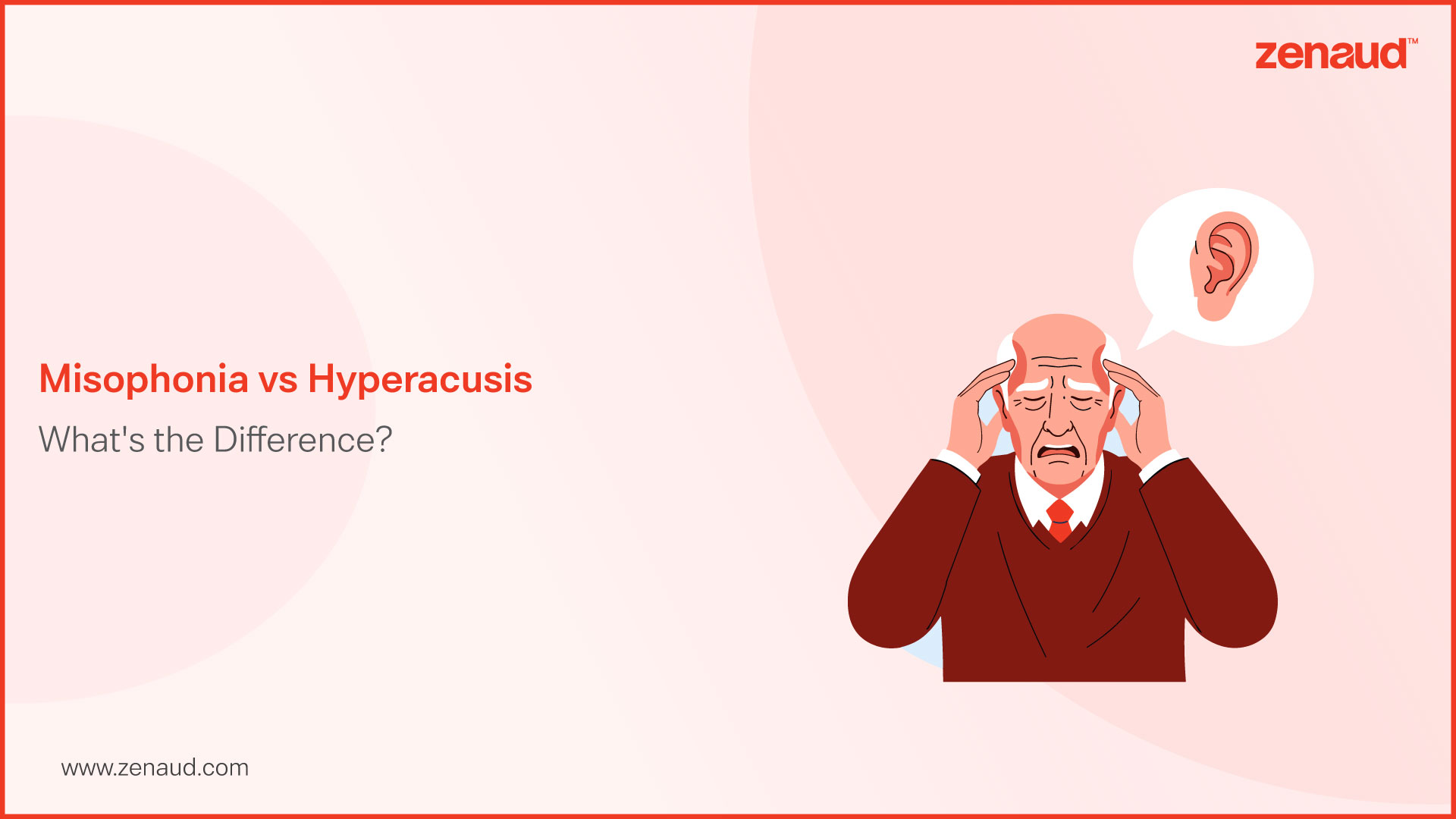
Not everyone experiences sound in the same way. One person grows tense at the sound of a colleague eating, while another recoils when a dish clatters in the sink. Both are forms of sound sensitivity, and they are frequently confused, yet they originate in different mechanisms and are managed differently. Understanding the difference between misophonia and hyperacusis makes it considerably easier to seek appropriate support.
Two Conditions, Two Distinct Responses
Misophonia is a strong emotional or physical reaction to particular sounds, usually soft and repetitive ones. Anger, anxiety, or disgust can surface within seconds. Volume is rarely the determining factor. What matters is the sound itself and the meaning the brain attaches to it.
Hyperacusis is distinct in this respect. Everyday sounds feel uncomfortably loud, sometimes painful, even when those nearby barely notice them. The difficulty lies in loudness rather than in the type of sound.
Emotional Reactivity Versus Physical Discomfort
A useful way to distinguish the two is to ask what provokes the reaction. If the trigger is a specific sound such as chewing, tapping, or breathing, and the response is irritation or an urge to leave the room, the pattern suggests an emotional reaction to the sound itself. If the trigger is volume, and the response is ear pain, pressure, or a sense of being overwhelmed, the pattern suggests a physical reaction to loudness.
Recognising the Symptoms
People whose reactions are triggered by specific sounds often describe:
- Sudden irritation or anger when a particular sound begins
- Tension, a racing heart, or anxiety during exposure
- Avoidance of shared meals, meetings, or social gatherings
- Difficulty concentrating while the trigger continues
Those whose reactions are triggered by loudness tend to report:
- Discomfort or pain from running water, traffic, or cutlery
- Pressure or fullness in the ear after noise
- Headaches or fatigue following time in busy places
- Regular reliance on earplugs
Understanding Common Triggers
Reactions to specific sounds are usually provoked by human, repetitive noises. Chewing, lip smacking, sniffing, throat clearing, and keyboard tapping are reported most often. The same person may tolerate loud traffic or music without any distress.
Sensitivity driven by loudness is far less selective. Once a sound crosses a certain level, almost anything can become distressing, from closing doors to children's voices. Crowded or echoing rooms tend to intensify the discomfort. This form of sensitivity can follow noise exposure, head injury, or an ear infection, and it sometimes accompanies tinnitus or hearing loss. Sensitivity to specific sounds, by comparison, is usually first noticed in childhood or adolescence.
Why an Accurate Diagnosis Matters
The two can coexist, which is one reason self-diagnosis is unreliable. A mistaken assumption may delay appropriate care.
Management differs as well. For loudness-related sensitivity, audiologists often recommend guided sound therapy with gradual, supervised exposure to everyday sounds. Prolonged earplug use is generally discouraged, since it can reduce the ear's tolerance further. Sound-triggered emotional reactions are more often addressed through counselling, cognitive behavioural approaches, and sound-based strategies that help the brain respond differently to specific triggers.
An audiological evaluation, including hearing thresholds and loudness discomfort levels, helps rule out underlying hearing concerns and guides the appropriate course of care.
Taking the Next Step
Neither condition reflects weakness or exaggeration. Both are genuine responses of the auditory and nervous systems, and both can be managed effectively with professional care. If persistent sensitivity to sound is beginning to affect your comfort, work, or relationships, a hearing assessment can offer clarity.
Book a consultation with Zenaud today at zenaud.com.
Related Blogs
What Is Hidden Hearing Loss? Symptoms You Shouldn't Ignore
By Sri Sai Koti Chennupati | Sept. 21, 2026
Hearing Fatigue: Signs, Causes and How to Manage It
By Sharanya Krishnan - Audiologist | Sept. 16, 2026
Contact us
We are here for all your hearing needs, from hearing tests to hearing aids. Fill out the form below, and we will give you a call soon.
Recent Blogs
By Team Zenaud | Nov. 23, 2026
By Team Zenaud | Nov. 18, 2026
By Team Zenaud | Nov. 16, 2026
By Team Zenaud | Nov. 12, 2026
By Team Zenaud | Nov. 9, 2026