HEARING TEST
Tuning Fork Test
By Team Zenaud | April 3, 2026
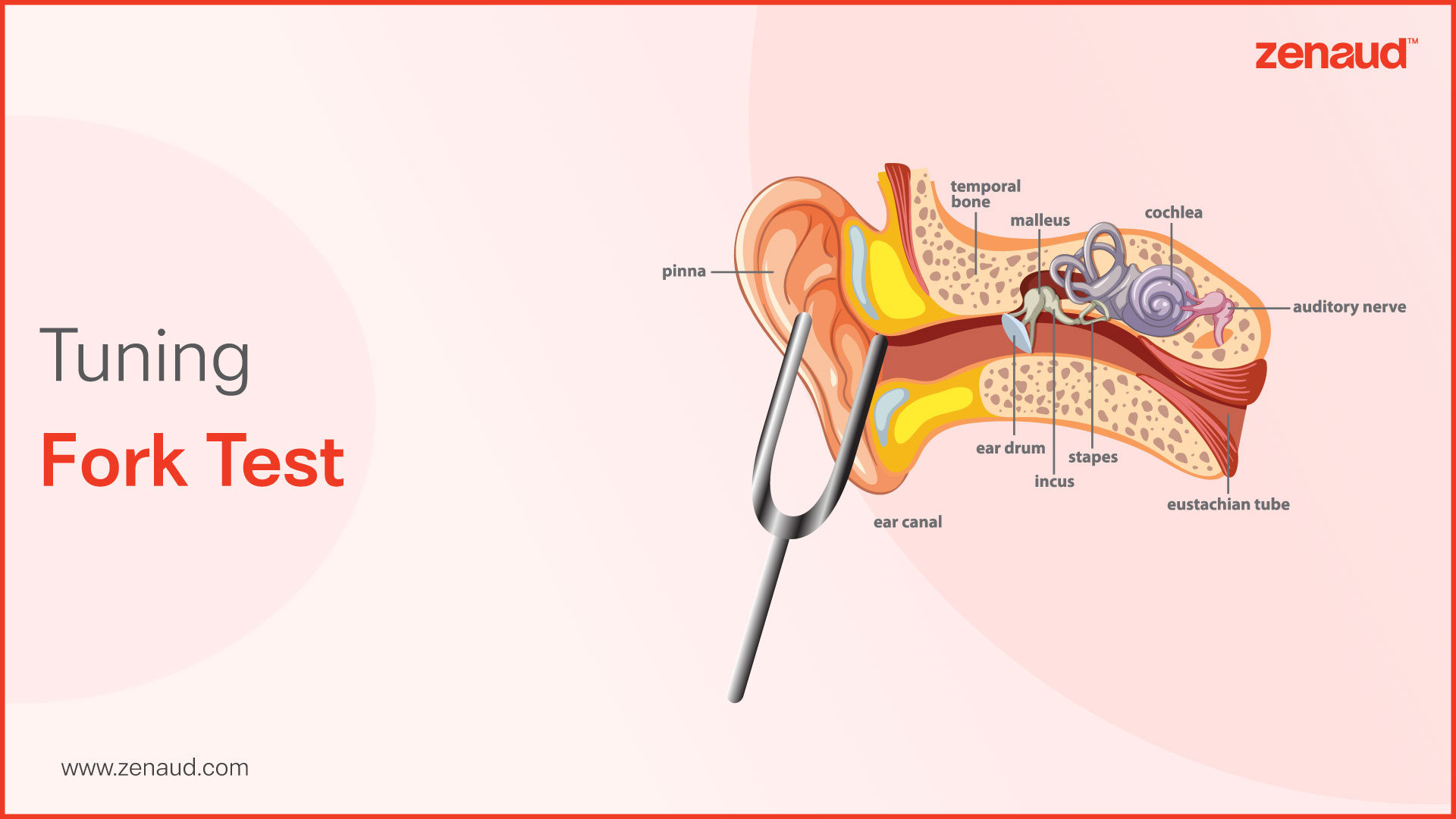
The Tuning Fork Test: A Simple Tool That Tells Audiologists Everything
Before the age of digital audiometers, soundproof booths, and bone conduction headsets, clinicians were already accurately diagnosing hearing loss using nothing more than a small metal instrument and a trained pair of hands. The tuning fork test has been a cornerstone of audiological and ENT assessment for well over a century — and despite every technological advancement that has followed, it remains a clinically valuable and widely used diagnostic tool today.
Understanding what these tests involve, what they can reveal, and how their results are interpreted gives patients a clearer picture of what happens during an ear examination — and why something so seemingly simple carries so much diagnostic weight.
What Is a Tuning Fork and How Does It Work?
A tuning fork is a two-pronged metal instrument that, when struck against a surface or the examiner's palm, vibrates at a precise, consistent frequency. In clinical audiology and ENT practice, forks tuned to 256 Hz, 512 Hz, and occasionally 1024 Hz are most commonly used — with 512 Hz being the preferred choice for most hearing assessments because it closely mirrors the speech frequency range.
When the fork vibrates, it produces a pure tone. That tone can be delivered to the ear in two ways: through the air (air conduction) or through the bones of the skull (bone conduction). The comparison between these two pathways is precisely where the diagnostic value of the tuning fork hearing test lies. A healthy ear hears equally well through both routes. Disruption to that balance points to a specific type or location of hearing loss.
The Rinne Test: Air Versus Bone
The Rinne tuning fork test — named after German otologist Heinrich Adolf Rinne — compares how well a patient hears sound conducted through air versus sound conducted through bone. It is performed by striking the tuning fork and placing it against the mastoid bone, the bony prominence just behind the ear, until the patient can no longer hear it. The fork is then immediately moved to sit just outside the ear canal.
In a person with normal hearing or sensorineural hearing loss, air conduction remains better than bone conduction — sound heard through the air is louder and lasts longer even after the bone signal has faded. This is recorded as a positive Rinne result.
When the result is negative — meaning bone conduction outlasts or outperforms air conduction — it signals a conductive hearing loss. Something is blocking or disrupting the normal passage of sound through the outer or middle ear: fluid, a perforated eardrum, earwax impaction, or a disruption to the ossicular chain. The Rinne test does not tell you exactly what the problem is, but it tells you with considerable reliability where it is.
The Weber Test: Lateralisation of Sound
Where the Rinne test compares pathways, the Weber tuning fork test compares ears. Developed by Ernst Heinrich Weber, this test involves placing a vibrating tuning fork at the midpoint of the forehead or the top of the skull and asking the patient where they hear the sound — in the centre of the head, in the left ear, or in the right ear.
In normal hearing, the sound is perceived centrally or equally in both ears. Lateralisation — the sensation that sound is louder on one side — is the finding that carries diagnostic significance. If the sound lateralises toward the poorer ear, it suggests conductive hearing loss on that side. If it lateralises toward the better ear, it points toward sensorineural hearing loss on the opposite side. It is a counterintuitive result that surprises many patients but reflects well-established principles of how the auditory system processes bone-conducted sound.
Tuning Fork Test Interpretation: Putting It Together
Neither the Rinne nor the Weber test is intended to stand alone. The real diagnostic value of tuning fork test interpretation comes from reading both results together and cross-referencing with clinical history and formal audiometry.
A negative Rinne combined with Weber lateralising to the same ear strongly suggests conductive hearing loss on that side. A positive Rinne combined with Weber lateralising away from the symptomatic ear points toward sensorineural involvement. When both ears show abnormal results in different patterns, the picture becomes more complex — and that complexity is exactly what specialist assessment is designed to untangle.
Interpretation also accounts for the limitations of the test. Tuning forks cannot quantify the degree of hearing loss. They cannot detect loss in both ears with equal symmetry reliably. And they depend on clear communication between examiner and patient. This is why they function as a screening and orientation tool — powerful for directing the clinical conversation, but always followed by formal audiological testing when indicated.
Why This Century-Old Test Still Matters
In a field that has embraced digital precision at every turn, the enduring presence of the tuning fork speaks to something important: good clinical assessment is not always about complexity. Sometimes, the most elegant diagnostic tool is the one that asks a single, well-formed question and listens carefully to the answer.
For patients, understanding these tests removes the mystery from what can feel like an opaque clinical encounter. For clinicians, the tuning fork remains what it has always been — a fast, portable, and remarkably informative window into the mechanics of hearing.
At Zenaud, every assessment begins with a thorough clinical evaluation — because the right diagnosis starts with asking the right questions, in the right order.
Concerned about your hearing? Book a comprehensive hearing assessment with Zenaud today.
FAQs
What is tuning fork test?
A tuning fork test is a quick hearing check using vibrations to assess hearing loss and its type.
How to use a tuning fork for hearing test?
A vibrating tuning fork is placed on the head or near the ear to compare sound conduction through air and bone.
What is the tuning fork test used for?
It is used to identify whether hearing loss is conductive or sensorineural.
What is a normal Weber and Rinne test?
A normal result shows sound heard equally in both ears (Weber) and air conduction better than bone conduction (Rinne).
Contact us
We are here for all your hearing needs, from hearing tests to hearing aids. Fill out the form below, and we will give you a call soon.
Recent Blogs
By Team Zenaud | Oct. 12, 2026
By Team Zenaud | Oct. 6, 2026
By Sharanya Krishnan - Audiologist | Oct. 3, 2026
By Dattatreya M | Sept. 30, 2026
By Sri Sai Koti Chennupati | Sept. 28, 2026