HEARING CARE
Human Ear Hearing Range
By Team Zenaud | April 7, 2026
What Is the Hearing Range of the Human Ear?
Close your eyes for a moment. Can you hear the faint buzz of a fan? The sound of typing? Maybe a distant bird call? Your ears are constantly working — quietly translating the world into sound. They can pick up the softest whisper, yet also handle the rumble of thunder.
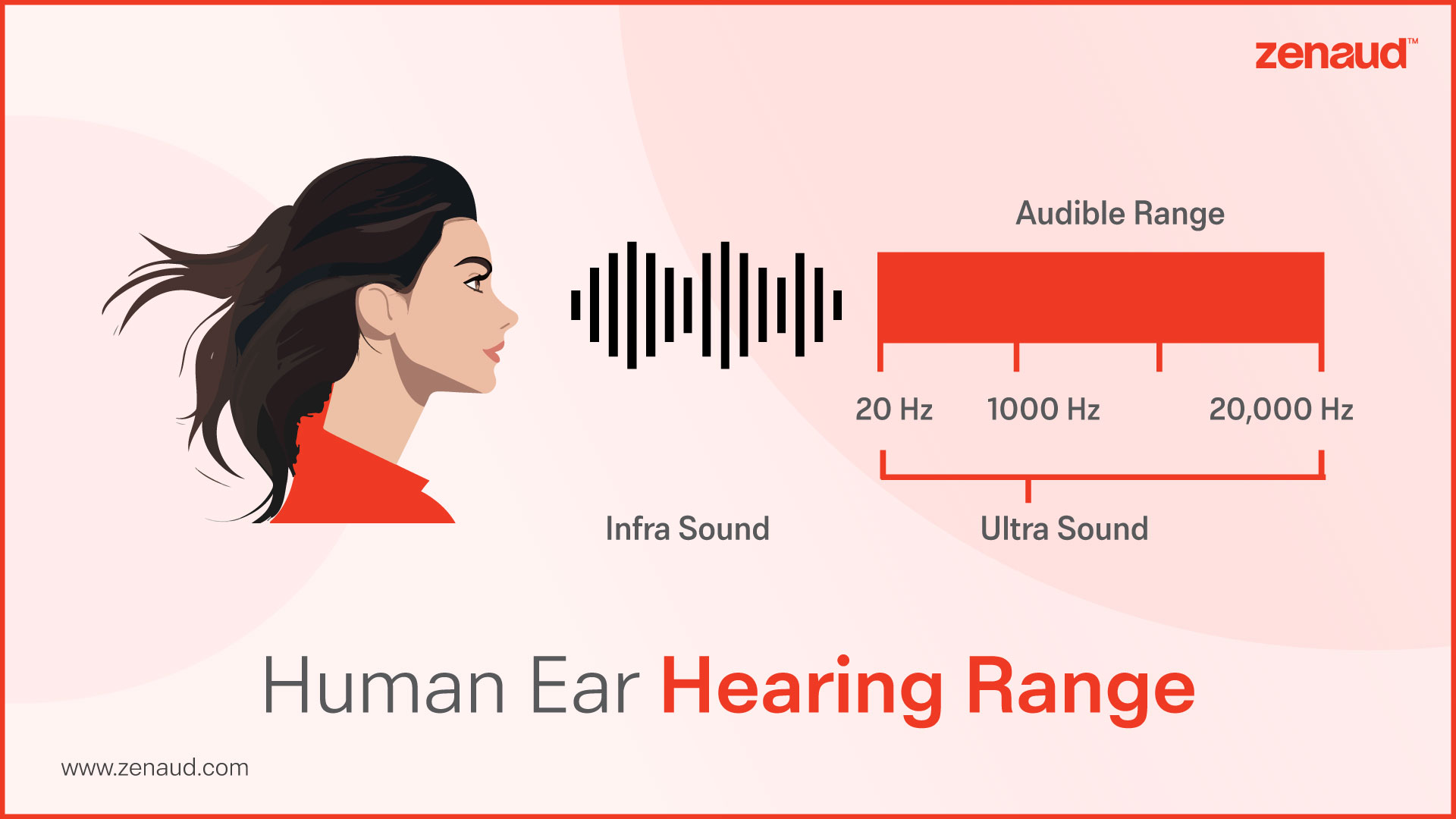
The human hearing range typically spans from 20 Hz to 20,000 Hz, though this can vary with age and overall hearing health. Understanding the human hearing range helps in choosing the right hearing aids or audio devices that enhance clarity across the most important speech frequencies.
That’s the beauty of the human ear hearing range — it allows us to experience life in all its tones and textures. But what exactly can the human ear hear? What’s too soft or too high-pitched for us to notice? Let’s explore what is the audible range of human ear and how it changes over time.
How Hearing Works
Every sound you hear — whether it’s a drum, a voice, or the rustle of leaves — is actually a vibration moving through the air. These vibrations are called sound waves, and they come in different frequencies.
Frequency simply means how fast those waves move, measured in hertz (Hz).
- Low frequencies sound deep — like a bass guitar or thunder.
- High frequencies sound sharp — like a whistle or a bird’s chirp.
Your ear catches these sound waves, turns them into electrical signals, and sends them to your brain. That’s how we make sense of the sounds around us.
The Hearing Range of Human Ear
Now, here’s the fascinating part: the hearing range of humans ear is typically between 20 Hz and 20,000 Hz (20 kHz), allowing us to perceive a wide variety of sounds from deep bass to high-pitched tones. However, the hearing range of humans can gradually narrow with age or prolonged exposure to loud noise, affecting the ability to hear certain frequencies clearly.
That means humans can hear from very low rumbles at 20 Hz all the way up to high-pitched sounds at 20,000 Hz. This entire spectrum is known as the human audible range in Hz, or simply the human audio frequency range.
Of course, not everyone hears the full range equally. Young children often hear up to 20,000 Hz, but as we grow older, the higher end of the range starts to fade. That’s why older adults might not notice the sound of a mosquito or the high ring of an electronic device anymore.
Breaking Down the Sounds You Hear
The human ear hearing range in humans can be categorized into three primary divisions, wherein each division is accountable for distinct sound types:
Low Frequencies (20 – 250 Hz):
These are very low and heavy sounds — thunder, bass drums and engine noise. A lot of times you can sense them even more than you hear them.
Mid Frequencies (250 – 4,000 Hz):
This is the area where most of the communication and noise of daily life occurs. It is the region where the pronunciation of words, sounds of laughter and the tunes of music are clear.
High Frequencies (4,000 – 20,000 Hz):
These make sounds more colourful — the singing of birds, the brilliance of music and the differentiating of “s” and “th” in speaking.
All these frequencies combined give a complete experience of the sound world. Lose one range, and the world becomes a little duller, quieter, or harder to understand.
Why Hearing Range Differs from Person to Person
While the hearing range of human ear is defined as 20 Hz to 20,000 Hz, no two people hear exactly the same way. Your personal range can depend on many things — your age, lifestyle, health, and even the sounds you’ve been exposed to over time. The human hearing frequency range typically spans from 20 Hz to 20,000 Hz, covering the spectrum of sounds the average person can hear. This human hearing frequency range may decline with age or noise exposure, making it harder to detect higher-frequency sounds like speech details.
Here are a few common reasons why hearing range changes:
- Age: With time, our ears naturally lose the ability to catch higher frequencies.
- Noise exposure: Loud music, traffic, or even headphones at high volume can wear down the ear’s delicate hair cells.
- Health: Ear infections, colds, or certain medications can temporarily affect hearing.
- Environment: People working in noisy settings often lose parts of their high-frequency range earlier.
That’s why regular hearing checks matter. They don’t just detect hearing loss — they show how your human audio frequency range is shifting over time.
When the Hearing Range Starts to Shrink
Hearing loss rarely happens overnight. It usually begins at the higher end of the human audible range in Hz.
At first, you might miss the sound of a distant ringtone or birds outside. Over time, you might find it harder to follow conversations in noisy places or catch softer tones in speech. If left unaddressed, your brain gradually stops processing certain frequencies — which makes listening feel tiring. But here’s the good news: hearing aids today can amplify only the frequencies you’re missing, helping you hear naturally again.
How to Test Your Hearing Range
Curious to know how well you can hear? A professional sound test can measure your exact human ear hearing range. You’ll wear headphones and listen to a series of tones at different pitches. The softest sounds you can detect at each pitch are plotted on a chart called an audiogram.
This test reveals which parts of your hearing range are still strong and which ones need support.You can also try online tests for fun, but they’re not as accurate — especially if you’re using normal headphones or there’s background noise. For a true picture of your human audio frequency range, always go for a clinical test.
Caring for Your Hearing Range
Your ears are delicate, and once the tiny hair cells inside are damaged, they can’t regenerate. The best thing you can do is protect the hearing you already have.
Here’s how to keep your human ear hearing range healthy:
- Turn down the volume — especially on headphones or earbuds.Give your ears regular breaks from noise.
- Use ear protection in loud environments like concerts or factories.
- Treat infections early and avoid poking your ears with objects.Get your hearing tested every few years — even if you think it’s fine.Small, consistent care can preserve your ability to hear the sounds that make life meaningful.
The Wonder of Human Hearing
Hearing is something that can easily be taken for granted. However, if you think about it, every second our ears do a miraculous job — they turn invisible air vibrations into emotion, music and connection.
The human ear hearing range lets us hear the quietest breath of a loved one and the loudest crashing of ocean waves.It's not merely frequencies or numbers that matter—it's about our perception of the world.
Thus, the next time you enjoy listening to your preferred song or to the sound of rain, just stop for a second. That’s your human audible range in Hz at work — transforming air into something you can feel.
Protect it, appreciate it, and listen deeply. Because your ability to hear the world is one of the most beautiful things you’ll ever have.
FAQs
1. What is the hearing range of the human ear?
Human hearing falls within the range of sounds that lie between 20 Hz to 20,000 Hz and from deep, base levels to the very high pitch sounds of all kind.
2. What is the audible range of human ear?
The human audible range is typically from 20 Hz to 20 kHz. However, this range continues to shrink with increasing age.
3. What is the human ear hearing range?
The human ear hearing range includes low, mid, and high frequencies — letting us hear voices, music, and the subtle sounds of daily life.
4. What is the human audio frequency range?
The human audio frequency range runs from 20 to 20,000 Hz, but most speech and music fall between 250 and 8,000 Hz.
5. Why does the hearing range of humans decrease with age?
As we get older, the delicate hair cells in our inner ear wear out naturally, making it harder to hear higher-pitched sounds.
Contact us
We are here for all your hearing needs, from hearing tests to hearing aids. Fill out the form below, and we will give you a call soon.
Recent Blogs
By Team Zenaud | Oct. 12, 2026
By Team Zenaud | Oct. 6, 2026
By Sharanya Krishnan - Audiologist | Oct. 3, 2026
By Dattatreya M | Sept. 30, 2026
By Sri Sai Koti Chennupati | Sept. 28, 2026