HEARING AIDS
Hearing Aids vs Cochlear Implant
By Team Zenaud | Feb. 6, 2026
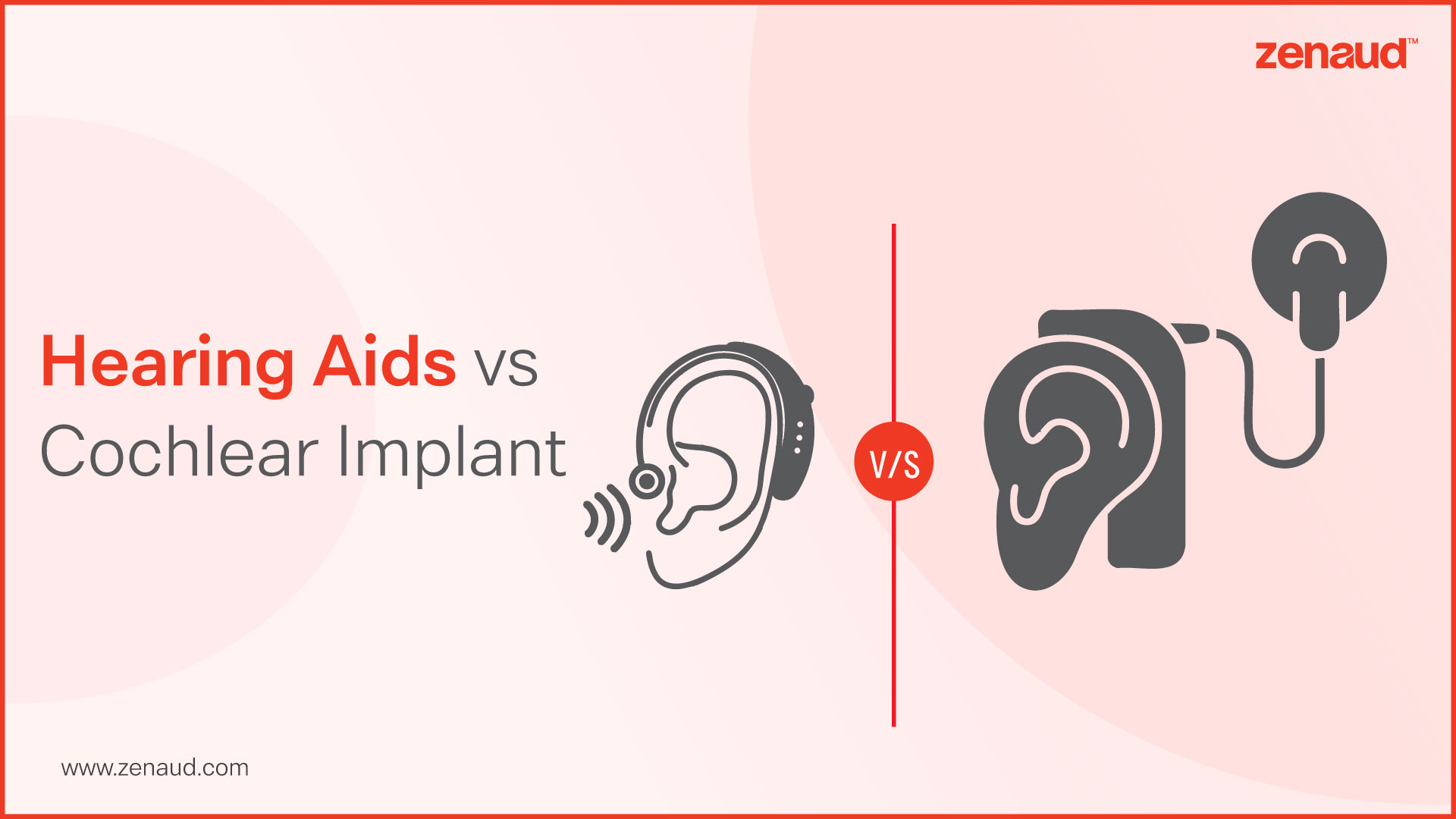
Hearing Aids vs Cochlear Implant: Understanding Which Option Is Right for You
People start experiencing major difficulties in their daily activities when hearing loss begins to impact their life, which leads them to search for assistance. The choice between Hearing Aids and Cochlear Implants create confusion for many people because they do not understand the distinction between both options.
The two devices enable better hearing for users through different and unique operational methods that apply to different degrees of hearing impairment. Your selection between the options depends on your specific hearing requirements instead of determining which option represents the superior choice.
Let’s break it down in a simple, human way.
How Hearing Aids Work
Hearing aids work by amplifying sound. They pick up sound from the environment, process it, and make it louder and clearer before sending it into the ear.
They rely on one important thing: the inner ear and hearing nerve must still be working to some extent. Hearing aids don’t replace hearing — they support and enhance what’s still there.
That’s why hearing aids are usually recommended for:
- Mild hearing loss
- Moderate hearing loss
- Moderate to severe hearing loss
For many people, modern hearing aids restore clarity, reduce listening effort, and make conversations comfortable again.
How Cochlear Implants Work
A cochlear implant works very differently.
Instead of amplifying sound, it bypasses the damaged inner ear completely and sends sound signals directly to the hearing nerve using electrical stimulation.
A cochlear implant has two parts:
- An external sound processor worn outside the ear
- An internal implant placed surgically under the skin
This option is usually considered when hearing aids no longer help — especially in cases of severe to profound hearing loss.
Hearing Aids vs Cochlear Implant: The Core Difference
The key difference in Hearing Aids vs Cochlear Implant is how sound reaches the brain.
- Hearing aids make sounds louder so damaged ears can still use them
- Cochlear implants replace the damaged hearing mechanism altogether
Because of this, cochlear implants are not a “stronger hearing aid” — they’re a completely different solution.
Who Is a Candidate for Hearing Aids?
Hearing aids are usually the first line of treatment and are suitable for most people with hearing loss.
You’re likely a good candidate if:
- You can still hear some sounds naturally
- Speech sounds unclear but not absent
- Hearing tests show usable inner ear function
- Hearing aids improve clarity during trials
Most people fall into this category — which is why hearing aids are far more common than implants.
Who Needs a Cochlear Implant?
Cochlear implants are recommended only when hearing aids no longer provide meaningful benefit.
You may be considered if:
- Hearing loss is severe to profound
- Speech understanding is very poor even with hearing aids
- Inner ear hair cells are extensively damaged
- Hearing loss affects communication despite best amplification
A detailed evaluation is required before recommending an implant, including hearing tests, imaging, and trial periods with hearing aids.
Bone Anchored Hearing Aid vs Cochlear Implant
Another common comparison people ask about is bone anchored hearing aid vs cochlear implant.
A bone anchored hearing aid (BAHA) sends sound through bone vibrations directly to the inner ear, bypassing the ear canal and middle ear. It’s mainly used for:
- Conductive hearing loss
- Mixed hearing loss
- Single-sided deafness
A cochlear implant, on the other hand, bypasses the inner ear entirely and stimulates the hearing nerve.
So the choice depends on where the hearing problem lies — middle ear vs inner ear vs nerve.
BAHA Hearing Aid vs Cochlear Implant
When comparing BAHA hearing aid vs the cochlear implant, it’s important to understand that they solve different problems.
BAHA helps when the ear canal or middle ear isn’t working well whereas the cochlear implants help when the inner ear itself is severely damaged
One does not replace the other. They are used for different diagnoses.
Bone Conduction Hearing Aid vs Cochlear Implant
The comparison between bone conduction hearing aids vs cochlear implants follows the same logic.
Bone conduction devices rely on a functioning inner ear. Cochlear implants do not.
That’s why audiologists never jump straight to implants — bone conduction or traditional hearing aids are always explored first when possible.
Surgery, Recovery, and Adjustment
One major difference people worry about is surgery.
Hearing aids do not require surgery and can be fitted immediately. Cochlear implants require surgery and post-surgical rehabilitation
After cochlear implantation, users go through a learning phase where the brain adapts to a new way of hearing. Sounds may initially feel mechanical or unfamiliar, but improve with time and therapy.
Hearing aids, in contrast, usually feel more natural from the start.
Cost and Commitment
Cochlear implants are significantly more expensive than hearing aids and involve long-term follow-up, mapping sessions, and rehabilitation.
Hearing aids are more flexible, easier to upgrade, and simpler to maintain for most users.
Cost should never be the only deciding factor — but it is part of the overall commitment.
The Right Choice Process
The choice to select between Hearing Aids and Cochlear Implants requires careful consideration because it needs to be made by professionals.
The correct decision requires assessment of:
- The degree and type of hearing loss
- The results obtained from hearing aid evaluations
- The capacity to comprehend spoken language
- The requirements and desired outcomes of the individual
Audiologists always recommend the least invasive option that gives the best hearing outcome.
Final Thoughts
Hearing aids and cochlear implants are not competitors — they’re tools meant for different stages and types of hearing loss.
Hearing aids provide sufficient sound restoration for most people. Cochlear implants serve as an alternative solution when hearing aids fail to provide sufficient sound amplification.
When deciding between bone anchored hearing aid and cochlear implant or between baha hearing aid and cochlear implant or between Hearing Aids and Cochlear Implant, the most essential aspect to consider is:
The right solution is the one that helps you hear comfortably, confidently, and fully — without doing more than what’s truly needed.
FAQs:
1. What is better, cochlear implant or hearing aid?
Neither is better honestly — hearing aids work best when some natural hearing remains, while cochlear implants are used when hearing aids no longer help.
2. Can a deaf person hear with a hearing aid?
A person with mild to moderate hearing loss may hear well with hearing aids, but those who are profoundly deaf usually need a cochlear implant.
3. Why cochlear implants instead of hearing aids?
Cochlear implants are chosen when hearing aids can’t provide clear speech because the inner ear is too damaged.
4. Are hearing aids cheaper than cochlear implants?
Yes, hearing aids are much cheaper since cochlear implants involve surgery, advanced technology, and long-term rehabilitation.
Contact us
We are here for all your hearing needs, from hearing tests to hearing aids. Fill out the form below, and we will give you a call soon.
Recent Blogs
By Team Zenaud | Oct. 12, 2026
By Team Zenaud | Oct. 6, 2026
By Sharanya Krishnan - Audiologist | Oct. 3, 2026
By Dattatreya M | Sept. 30, 2026
By Sri Sai Koti Chennupati | Sept. 28, 2026